

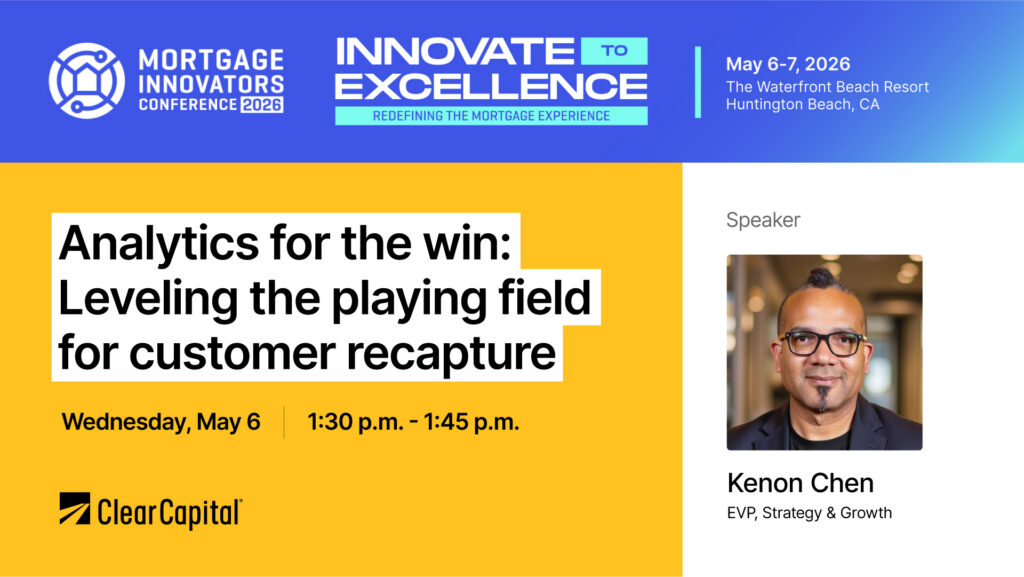
In this Tech Talk from the Mortgage Innovators Conference, Kenon Chen, EVP of Strategy and Growth at Clear Capital, explores how lenders can capture massive market share in today’s rapidly changing mortgage landscape.
Kenon breaks down why physical branch proximity no longer drives brand trust, making a digital-first, experience-driven strategy essential for winning over modern borrowers. He addresses the common challenge of internal silos created by scaling, which often lead to fragmented customer experiences and lost conversions, and introduces unified analytics as the “bluetooth” needed to seamlessly connect every touchpoint from exploration to closing. By leveraging context-aware AI models and smart APIs, lenders can deliver a single version of truth across the customer journey, boosting brand loyalty and driving a ~30% increase in actionable leads without requiring a massive tech budget.
Watch the full presentation or read the transcript below to learn how you can take control of your customer experience and level the playing field.
Video source: Mortgage Innovators
Today, I really want to talk a little bit about how to level the playing field against what’s going on right now, which is massive consolidation in the industry—a new playbook for generating customer experience, and ultimately, I think, an opportunity to seize market share.
It’s interesting that, with all this going on in the headlines, the largest lender only has 6% market share. And that’s kind of unusual in our space. If you look at other spaces that are regulated—you know, like insurance, banking, real estate, etc.—10% or more by the dominant player is much more common, and we’re still sitting below 10% for the largest lender. But it wasn’t always like that. Do you guys remember back after the financial crisis, there was a certain lender that had dominant market share? Who was that? Wells Fargo.
After 2008, going into 2010 to 2012, they were originating one out of every three loans—33% market share. And I remember that time because it was like you couldn’t get away from Wells Fargo, right? They were everywhere. And their strategy was really, really interesting because in the fallout of the financial crisis, there was a lot of opportunity to gobble up competitors, there was a lot of opportunity to step into markets that maybe had been left underserved, if you will. And they did it really, really well.
And what their playbook looked like was: first of all, they had massive physical distribution. So, they had an incredible branch network that was everywhere, and you can kind of see it on screen once that’s up there—they just had little red dots everywhere. They also had a multi-product ecosystem. So, when you went into a branch, right, they had a really good cross-sell understanding of what was available to the customer. They surrounded their customers with opportunities. And from an operational efficiency standpoint, I just remember at the time working with them, they were aggressive about operational efficiency. Things had to be done the same day, queues were worked through really rapidly, and they had some control over their own technology.
Well, I think that opportunity is here again for massive market share. We’re in a similar situation, right? Post-COVID, we had a rapid change in the market in 2022. And we’re seeing again the opportunity for consolidation, we’re seeing the disruption of technology coming into play. And so this idea of gaining massive market share again is possible.
So what does that look like? Well, the old playbook is gone. Instead of physical location driving brand trust, proximity driving brand trust, now it’s about experience. Experience is greater than proximity when it comes to creating market share. We see a digital-first strategy. You just can’t physically be in front of all the customers anymore. You digitally acquire customers now.
And so that makes it more and more important in this world of digital noise, if you will—you know, you can’t put someone on a nice luxury couch and surround them with drinks and talk to them, right? You’re fighting against everything else that’s online. You’re fighting against all that digital noise. So the way that you win against digital noise is to have a seamless experience, to have a journey that’s consistent all the way through so that every touchpoint that you have with someone leads to the next step along the journey. So continuous engagement also becomes important.
So I think the winners right now are going to be the ones that create a unified brand experience. These are the folks that have really thought about what it looks like from a consumer’s vantage point to be in the servicing portal, looking at their current mortgage, understanding their current home equity position. You know, these are the same people that are responding to marketing campaigns and seeing what it is that is available to them based on their current situation. These are the same people that might be shopping for other homes in the area, maybe seeing what they could sell their home for. These are the same people that are in the loan process, filling out an application and really hoping that they get approved.
So having a unified experience all the way through becomes super crucial and important. But there’s a problem: as you try to scale, as you try to optimize all these different areas, it’s natural that you end up creating silos within your organization.
That’s just the reality of it: scaling creates silos. What I mean by that is that, you know, what might be best for the servicing group, what might be best for the marketing group, what might be best for the point of sale / loan origination—all of that, is everyone wants to optimize and create efficiency for the tool that makes most sense for them, right? And where that creates problems is if that’s also the approach you take to data and analytics, where each group is deciding what are the analytics you want to show, what are the analytics that you want to use, instead of thinking about it from a unified perspective. So as you get really good at optimizing and creating efficiency, sometimes it’s easy to get really bad at showing unified information.
Let me give you an example. This is what my point of view looked like on the plane coming here yesterday. I have an issue, I think. But seriously, like, I often have all three devices out at the same time. You know, and they’re all… man, I’m spending a lot of money on Wi-Fi as well, right? But I’ve got my phone doing quick chats and emails, I’ve got my laptop working on the presentation that I’m doing right now, and then watching—might be also watching some TV shows and things on my iPad, you know, to just give myself a mental break as I’m doing that, right?
But I’m optimizing as one person. I’m optimizing across multiple devices all at the same time. That’s pretty normal, I think, in the world of how consumers interact with data. And imagine what this would be like without seamless communication of data between these devices—without Bluetooth, without AirPlay, without any way of seeing the same thing you’re doing across multiple devices.
Well, often, that’s what we see being deployed out there in the industry, is showing the consumer a disconnected world between the different experiences that they’re having. You know, since we’re a property analytics company, I’ll use property analytics as the example: where you’re logging into your mortgage portal and you’re seeing what your home is currently worth, but when you go out and browse it on your favorite real estate portal, you see a different number. Maybe you even see three different numbers at the same time on the same site, right? And then you get in and you actually fill out your loan application, and you see yet another number that decides what you might qualify for.
This, I think, is old-school thinking. This is where we’ve thought about maximizing to cost instead of experience, where we’ve employed things like marketing analytics that, honestly, didn’t care much about what it took to underwrite that loan, what it took to have a value that investors would be confident in. So often, we’re showing one number hoping that that hooks them to get to the next step. But then when they get to the next step, there’s friction and distrust because the next number they’re presented with is different from the number they acted on.
And then when you look at sites like Credit Karma and other consumer finance portals, they’re also being shown numbers—what their current home equity is, what their borrowing power might be. So what happens is you might get more attention, a bigger funnel up top from a marketing standpoint, but then you lose the conversion.
So, unified analytics becomes your secret weapon, just like Bluetooth, where it’s okay to have separate portals for servicing, for marketing, for point of sale, LOS, etc. But if you’re using unified analytics, suddenly all these things play nicely together. And as you let people explore, shop, apply, close, you start with accurate analytics upfront that you can use all the way through. I think there’s the expectation now from consumers that if you show it, they believe they can act upon it, instead of “show it and then talk to me and maybe we’ll see.”
Some of the benefits that we’ve seen from people adopting this—and I’ve seen some of the largest digital-first lenders start to take this approach, as well as I’ve seen home equity-focused lenders really start to embrace the idea of lending analytics during marketing and then carrying that all the way through:
- We’ve seen reduced duplicate costs, so you’re not buying multiple datasets over and over again.
- We’ve seen increased certainty for borrowers.
- We’ve seen it create kind of viral brand loyalty. People aren’t going to talk about a rough experience they had in the same way they’ll talk about, “Man, it was super easy, it just worked for me, you should try it.”
But really in the numbers, when we see accurate analytics being used upfront as early as servicing or the top of the funnel, we’ve seen a ~30% increase in actionable leads by taking this approach.
AI is one of the things that makes this possible. Mainly what AI has changed, I think, is that the quality of analytics, the quality of accuracy, is now table stakes. There is no more differentiation between a marketing model, a lending model, an investment model. You really can accomplish all these things together because of the ability with supervised learning to build national models that really work well at scale and can be easily consumed.
The other thing we’re seeing is smart APIs. An API shouldn’t just be a transactional thing where, “All right, I get an answer, I go back, and now I have to do a whole bunch of things to bring all these integrations together.” Now, smart APIs are context-aware, where they remember the thing that you asked for, and then you can recall that again, and you can add on additional information that you need. You can decide, as the lender, when to show your borrower different information or whether to recall the same information that you’ve already shown them at a different point in the funnel. This is going to keep changing with AI. Model Context Protocol is going to provide new ways to stitch all of this together.
So I strongly believe that the next dominant lender won’t look like the last. And this story has not been written yet. It’s not just about who’s in the headlines right now. It’s really about any of you. Any of you has the opportunity to create this because, again, it’s a lot less costly now to provide a unified experience than it used to be. That doesn’t mean you have to own all of your own tech and have a massive budget to develop all this; it just means that you have to make smart choices about where you deploy analytics.
So if you want to level the playing field, first of all, don’t let someone else’s portal define your customer’s experience. We know people are already browsing online, but you can take control of this. You can be the ones to determine what information you give them early to help them make a good decision later on, and to have certainty in the process.
Appreciate it. Thanks so much.